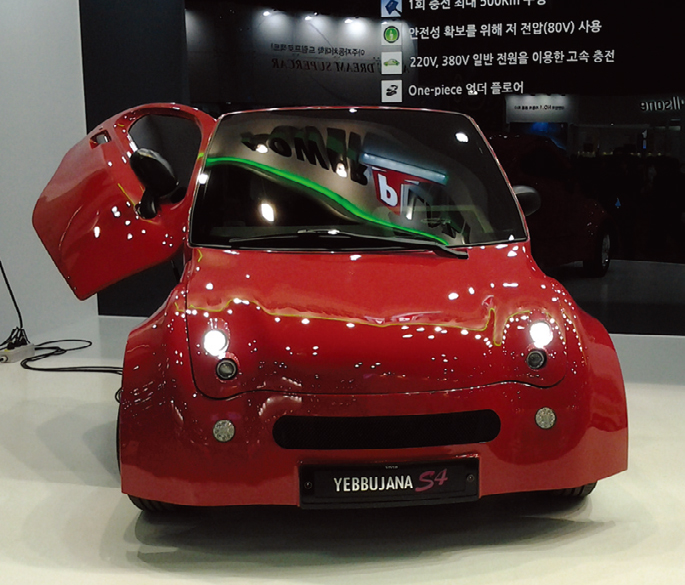
 The South Korean electric car market is expected to see intense competition among three major carmakers this year.
The market, which had only one electric car model Kia Ray, will be joined by the SM3 Z.E.(Zero Emission) of Renault Samsung Motors and the Chevrolet Spark of GM Korea.
The competition is projected to be fiercer next year as Kia Motor is set to unveil its electric model Soul, while BMW will be launching the i3 and i8.
Renault Samsung decided to manufacture the SME Z.E. at its plant in Busan, starting October this year. The car maker will abandon importing the electric model for supply to some of the nation’s public organizations and initiate its mass production on a full scale.
The Chevrolet Spark, which will be produced at GM Korea’s plant in Changwon, is a compact electric car similar to the Ray. But the GM Korea’s model has a maximum output of 130 horsepower, twice that of the Ray, and a 55.3 kg.m torque three times larger than that of the Kia Motors’ model.
Such competition in the Korean electric car market is likely to intensify next year. Kia Motors plans to release the compact sedan electric Soul to vie with the SM3 Z.E., while BMW seeks to face domestic carmakers head-on with the i3 and i8.
Foreign and domestic carmakers are eager to expand the Korean electric car market, following a similar entry to the hybrid market. But some pointed out that it is still premature to commercialize electric cars on a massive scale, since the government’s policies for purchase subsidy and related infrastructure are still in their infancy.
As of now, electric cars provided to public institutions are granted tax breaks and purchase subsidies. The Ray is offered to public organizations with a tax break worth 45million won ($39,838) and the SM3 Z.E. worth 65 million won. A private organization has to pay 20 to 30 million won for buying one unit of the Ray and 40 million won for the SM3 Z.E. even with benefits of the same level of the tax break and subsidy, which indicates the effort to promote massive use of electric cars still faces serious obstacles.
The Korean government has enacted the Air and Environment Act, which takes effect next year, imposing penalties on vehicles with higher carbon emissions and giving subsidies to those with lower emissions.
Nonetheless, the new law offers up to only three million won in subsidies to electric cars. Other issues troubling the mass commercialization is the lack of charge stations and a unified charge standard. The nation has only 80 charge stations and does not have a standardized charge unit and such issues cannot be resolved over the short term.
Korean-electronics.com | Blog Magazine of Korean electronics, brands, and goods



 Korean-Machinery.com
Leave a comment