Located in Paju, “the land with heaven’s blessing,” facing the Han River and Imjingak, Bookcity is a national cultural and industrial complex, with an area of about 1,586,000 sq.m. It was established by publishers with a will and purpose to cultivate the adaptability of individual culture in this global era and to accomplish modernization as well as qualitative improvement in the distribution structure.
 Bookcity, having realized “the ‘Spirit of Joint linkage,” attracted a number of notable firms related to publishing, including publishing companies, printing companies, paper suppliers, distribution centers, etc. It also attracted specialists in architectural and environmental arts who felt the need for an eco-friendly industrial city. It is now viewed as a cultural center and is visited with pleasure by people from all parts of the world.
Bookcity aims at being an “Eco-friendly Culture City Filled with Dreams and Etiquette,” where human beings are one with nature and culture blends in with industry. The city projects itself as a space alive and vibrant with nature. It is a new epoch in city culture and is one of the notable places in Korea where about 100 buildings, each with its own unique beauty, is built with an architectural artistry that harmonizes with nature.
Located at the heart of this Bookcity, the Asia Publication Culture & Information Center is a large complex space of culture covering an area of approx. 13,200 sq.m. for the development of Korean publishing culture.
Selected through an award-winning competition, the design work by Kim Byung-yoon for the Asia Center is a building that portrays the harmony between natural ecology and architecture. Kim Byung-yoon was awarded the 14th Kim Soo-kun Architectural Culture Prize in 2004. The ridgeline, with Mt. Simhak as the backdrop, includes both a view of the underwater city and ground city depending on the angle of observation.
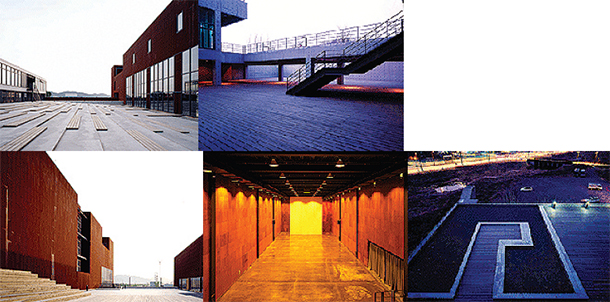
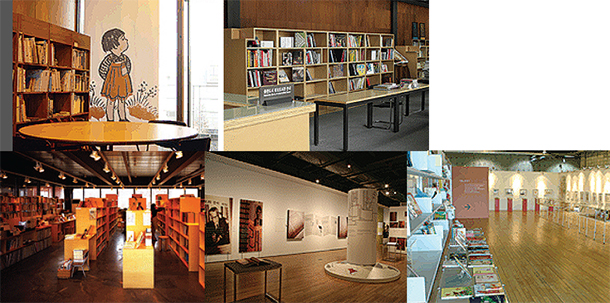 The design specified the use of weather-resistant steel plate, wood, glass, etc. for exterior materials and thoughtfully considered the architecture and its surrounding environments to allow them to naturally blend in with each other with the passage of time. Additionally, the reeds along the waterways convey the concept of an eco-friendly book town.
 The architectural guidelines for Bookcity takes into consideration the mutual relationship among approximately 100 unique buildings and the surrounding natural factors. Therefore, in spite of the tremendous scale and diversity, each place is connected organically by materials projecting a feeling of harmony and order.
The Asia Publication Culture & Information Center operates an Information Support Center for publishing and art activities. The center is equipped with a Multi-Purpose Hall and a Grand Conference Room to support academic exchange activities such as international book fairs.
The center also has an Event Hall and an Image Exhibition Hall to serve as venues for multi-purpose cultural events such as the public performances, exhibitions, etc. Outdoor spaces such as the Event Square Plaza, the Asia Square, and the Water Garden attract artists as an alternative space for hosting Madangguk (Korean traditional plays), the other performances, music concerts, and sculpture exhibitions.
 The center also attracts the general public as a place for rest and relaxation, in a space that is in harmony with nature both from a functional and an aesthetic point of view.
The Asia Publication Culture & Information Center is the driving force for preserving the spiritual culture of Korea that will concentrate its effort on bequeathing the value and importance of the Book to the next generation. Besides this, the center will play as a role as new cultural body transmitting harmony between city and nature, book and culture, architecture and art within the established concept of Bookcity.
korean-machinery.com | Blog Magazine of korean-machinery, brands and Goods



 Korean-Machinery.com