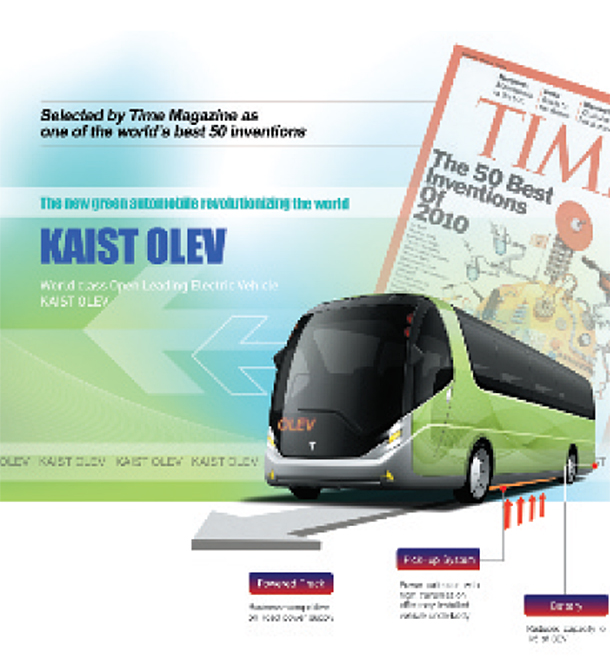

On-Line Electric Vehicle(OLEV)

1405M42https://korean-machinery.com///inquiry[INQ. NO. 1405M42] On-Line electric vehicle(OLEV) developed by KAIST operates on the electric energy converted from the magnetic field which is generated by electric power cables laid under the road (15 cm), using the pick-up devices mounted on the bottom of the vehicle.

The OLEV system doesn’t need charging stations because the vehicle is charged wirelessly in real time while running on the road. Since it’s battery capacity also is reduced to 1/5 of a typical pure electric vehicle, the OLEV is regarded as an enabling technology to speed up the commercialization of electric vehicle.

The OLEV technology was successfully applied and demonstrated in Seoul Grand Park by installing about 400m of power cables on 2.2km circular track and operating an OLEV tram. Furthermore, KAIST Wireless Power Transfer Research Center has decided to launch the electrification projects in Park City, Utah, United States and Kuala Lumpur Airport, Malaysia.


korean-machinery.com | Blog Magazine of korean-machinery, brands and Goods
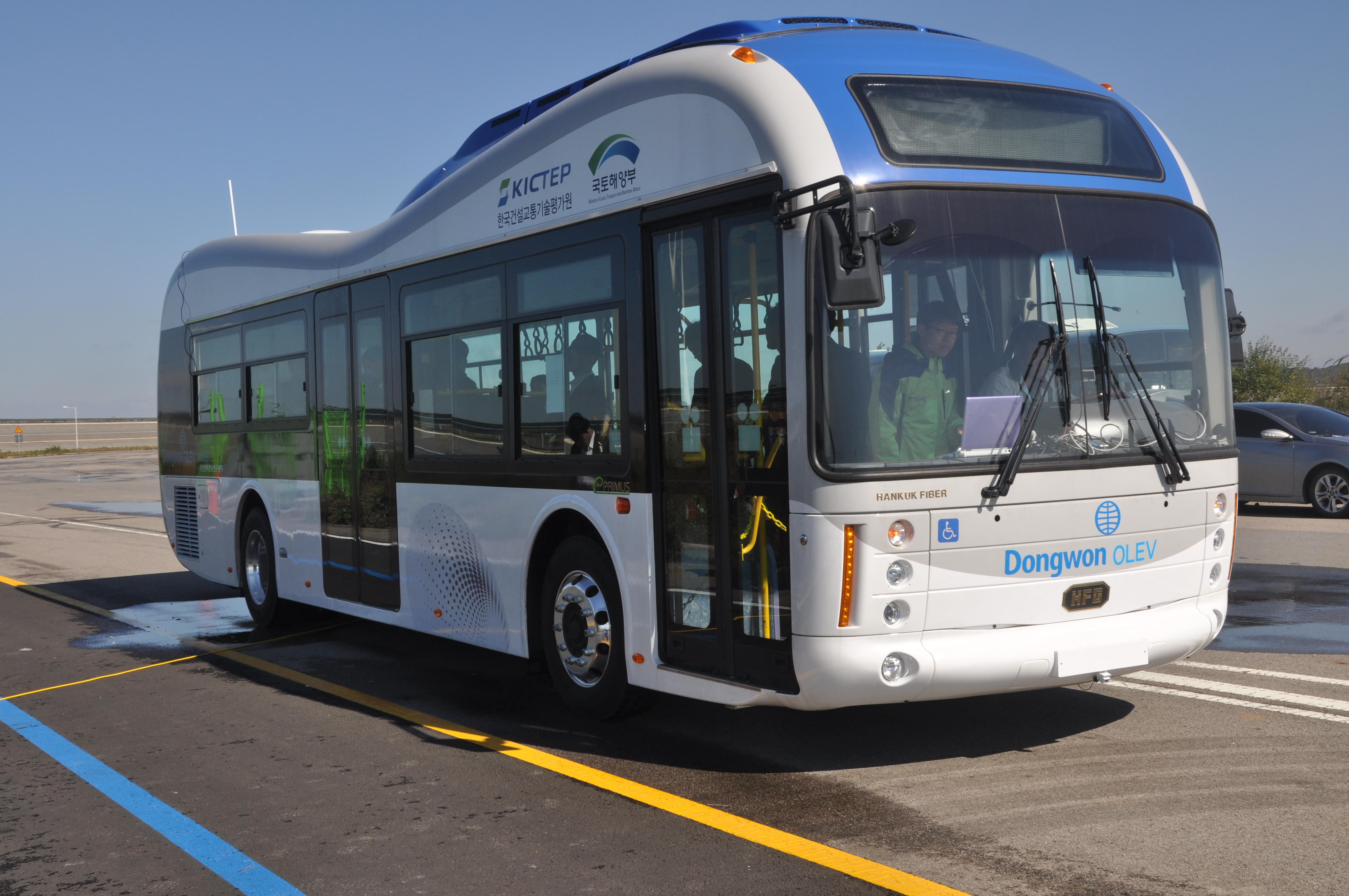
On-Line Electric Vehicle (OLEV)

DSC_0533 (31)


OLEV (On-line Electric Vehicle) technology uses inductive coupling and wireless electromagnetic transmission to power electric vehicles (cars, buses, vans etc) during operation. This is achieved by attaching pick-up coil sets under the bottom floor of an electric vehicle in order to receive electromagnetic fields from power cables installed under the road surface. The power is also used to charge an on-board battery which is used to power the vehicle when it is off line. These vehicles use one fifth of the battery of a normal electric vehicle. With a ground height of 20cm and a 75kW power capacity, an OLEV can achieve a transmission efficiency of 83%.


사본 - p10000000000ab7


The OLEV developed by KAIST operates on the electric energy converted from the magnetic field which is generated by electric power cables laid under the road (15 cm), using the pick-up devices mounted on the bottom of the vehicle.

The OLEV system doesn’t need charging stations because the vehicle is charged wirelessly in real time while running on the road. Since its battery capacity also is reduced to 20% of that of a typical pure electric vehicle, the OLEV is regarded as an enabling technology to speed up the commercialization of electric vehicles.

The OLEV technology was successfully applied and demonstrated in Seoul Grand Park by installing about 400m of power cables on 2.2km circular track and operating an OLEV tram. Furthermore, KAIST Wireless Power Transfer Research Center has decided to launch the electrification projects in Park City, Utah, United States and Kuala Lumpur Airport, Malaysia.


KAIST Wireless Power Transfer Research Center
193, Munji-ro, Yuseong-gu, Daejeon, Korea
Tel:(82-42) 350-6622 Fax:(82-42) 350-6689
E-mail: sheum@kaist.ac.kr

If you want more information about ‘Charging Control for Automotives’, please contact us.
Korean-machinery.com | Blog Magazine of Korean machinery & automotives