Exports by Eight Major New Industries Hit US$ 31.47 Billion in 1st Half, Proving Their Value as Driving Forces behind Exports

https://korean-machinery.com///inquiryExports by new industries are growing at a higher rate than total exports. The proportion of new industries’ exports in total exports is on a gradual rise, turning heads toward eight new industries including electric cars, robots and bio-health products.
According to the Ministry of Trade, Industry and Energy, exports by the eight new industries in the first half of the year amounted to US$31.47 billion, accounting for 11.3% of Korea’s total exports. Except for solar power generation exports, they shot up 20% from the previous year.
Exports of the seven items, excluding robots, showed increases.
Next-generation semiconductors and next-generation displays took the lead in driving up overall performances while new energy, bio-health and aerospace exports contributed to a spike in exports by new industries.
Exports of electric vehicles in the first half of the year boomed by 90.9% thanks to strong sales in Europe, which boasts of good charging infrastructure, and the launch of Korean automakers’ main electric car models in the United States.
In the aerospace sector, Corporate Korea delivered six Korean-made T-50s and eight FA-50s, and exports rose due to an increase in exports of aircraft parts in the first half.
Next-generation displays posted record-high biannual earnings, driven by rising demand for OLEDs for smartphones and increased TV sales at home and abroad.
A hike in prices of next-generation semiconductor NAND flash semiconductors and a rise in demand for them significantly elevated MCP exports and exports of system semiconductors switched to an increase from a drop in the previous year.
Exports of high-tech fiber and high-priced synthetic resin rose thanks to an increase in demand for cuttingedge new materials sparked off by a global economic recovery
Exports of finished drugs and biopharmaceuticals edged up in emerging markets of bio-health products and exports of medical devices such as ultrasound imaging devices inched up.
Exports of EVs, batteries for electric vehicles, and smart meters, which are features of the new industry energy, increased sharply in the first half.
Since the first introduction of the solar power HS code this year, the solar power industry exported US$1.26 billion in the first half of the year. Among total exports, PV modules and polysilicon accounted for 55% and 37%, respectively.
Exports of batteries for electric cars and ESSs rose in the first half of the year as demand for electric vehicles grew among major automakers in the EU and the United States.
On the other hand, despite the increase in exports of production robots to India and Vietnam, robot exports recorded a slight decrease in the first half of the year due to the delayed launches of new products and intensifying competition in Europe, the main market.
Among the eight new industry items, six new items –- electric cars, aerospace, new energy industry, nextgeneration displays, next-generation semiconductors and advanced materials –- enjoyed double-digit export growth and all items except for robots posted increases.
“Also in the second half of the year, exports are expected to climb, led by next-generation semiconductors and displays. It is also forecast that the launches of electric cars and service robots will play a positive role in exports by the new industries,” said Lee Min-woo, an assistant manager of the Import and Export Department at the Ministry of Trade, Industry, and Energy. “The Ministry of Trade, Industry, and Energy announced that the ministry will check Korean industries’ international competitiveness fields related to the 4th industrial revolution through the eight new industries’ export statistics and utilize them as basic statistics for new industrial policies.”

< Source: KITA>

korean-machinery.com | Blog Magazine of korean-machinery, brands and Goods
Koreas exports up 13.4% on year in May in longest winning streak since Dec 2011

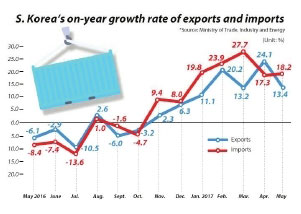
https://korean-machinery.com///inquirySouth Korean exports grew 13.4 percent on year to US$45 billion in May, extending a winning streak for the seventh straight month on the back of robust demand for electronics components and recovery in the global steel and shipbuilding markets. However, both growth and volume slowed from the previous months.

According to preliminary data by the Ministry of Trade, Industry, and Energy Thursday, the last time exports maintained growth for so long was in December 2011.

Out of 13 mainstay export items, nine grew. Semiconductor shipments surged 63.3 percent on year to reach an all-time monthly high of $7.99 billion. Solid-state drives that act as a replacement for hard disc drives were shipped in a record volume of $440 million in May.

However, exports of wireless devices plunged 37 percent despite the release of new smartphones by Samsung Electronics and LG Electronics.

Shipments to China rose for the seventh month in a row, gaining 7.5 percent despite the diplomatic row over the U.S. antimissile system deployment in Korea. Exports to the United States fell 1.9 percent due to sluggish performance in cars, car parts, and wireless devices. Exports to other areas all grew. Imports gained 18.2 percent to $39.1 billion, delivering a surplus of $6 billion. Overall, Korea has raked in a trade surplus for 64 consecutive months.

< Source: KITA>

korean-machinery.com | Blog Magazine of korean-machinery, brands and Goods
Scrapping FTA to Damage U.S. more than Korea

https://korean-machinery.com///inquiryScrapping the free trade agreement (FTA) between Korea and the United States will damage the U.S. more than Korea as the drop in U.S. exports to Korea will be steeper than the fall in Korea’s exports to the U.S. Instead, the U.S. is likely to demand a partial revision, including reintroduction of a merchandise processing fee (MPF), a think tank said recently.

The Korea Institute for Industrial Economics and Trade prepared the report on how changes in the Korea-U.S. FTA (KORUS FTA) will affect exports and imports. The Ministry of Trade, Industry and Energy requested the report earlier this year following U.S. President Donald Trump’s inauguration.

Trump has been criticizing trade deals, including the one with Korea, as “job killers” since he was campaigning for the election, prompting speculation the U.S. will push for the deal’s renegotiation.

The institute said there are three possible scenarios for the KORUS FTA: the U.S may demand a total scrapping or partial revision or maintain it.

If the bilateral deal is scrapped, the two countries will apply tariffs according to the most favored nation (MFN) treatment of the World Trade Organization (WTO). As a result, Korea will apply tariffs between 4 and 9 percent and the U.S. 1.5 to 4 percent. Both now apply near-zero tariffs under the KORUS FTA.

If tariffs rise because the deal is scrapped, Korea’s exports to the U.S. are expected to decrease by $1.3 billion while U.S. exports to Korea will plunge $1.5 billion. Since it means the U.S. trade deficit with Korea will increase by $200 million, the institute said it is unlikely the bilateral deal will be dropped.


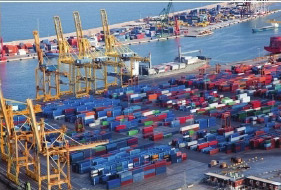
The U.S. may choose to maintain the KORUS FTA and resort to other measures to restrict Korea’s exports. For instance, it may strictly apply a country-of-origin clause in the deal. The institute expected small and medium enterprises to be hit hardest because it is costly for them to meet this clause.

If the U.S. strictly applies the clause, it is likely to decrease Korea’s exports by $400 million. But the report notes that the Trump administration would have no political gain if it leaves the deal as is.

The institute expected the deal’s revision is the most likely scenario. In that case, the U.S. may want to revise the MPF exemption clause. U.S. Customs charges MPF on imports, but the KORUS FTA exempts Korean goods. If the U.S. levies MPF on Korean goods, it will increase their price. Korea’s exports to the U.S. are then expected to decrease by $200 million, according to the institute.

However, some experts doubt the MPF will be the target since the U.S. exempts it in most of the FTAs it has signed. And it hasn’t mentioned the MPF.

The United States Trade Representative (USTR) noted in a report that “Increased access to Korea’s automotive market for U.S. automakers remains a key priority for the United States.”

korean-machinery.com | Blog Magazine of korean-machinery, brands and Goods

KAI wins $336 mn order to supply WTP to Airbus by 2030

https://korean-machinery.com///inquiry

Korea Aerospace Industries (KAI), South Korea’s dominant aircraft manufacturer, has won a 380 billion won ($336 million) contract with Airbus of the United Kingdom to additionally supply A320 wing top panels (WTP) between 2026 and 2030, the company announced on recently. Its first order for this year is an extension of the previous contract that will end in 2025.

WTP is an essential part of an aircraft, with a size of 16 meters (m) in length and 3.5 m in width, and composed of the blade surface and main frame.

The A320 is the best-selling model with about 13,000 aircrafts ordered from customers around the world and about 7,400 of them in service. Amid the growing demand for the A320, KAI has increased WTP production for the A320 since it first signed the contract with Airbus in 2011 and WTP now accounts for 40 percent of its total sales to the A320.

KAI also plans to ramp up its efforts to further expand orders to meet the growing demand for the A320 and diversify its income sources by exploring new markets. It will seek Risk Sharing Partner (RSP) projects to attract new customers and expand its presence in Southeast Asia to promote Korea’s home-grown helicopter Surion, KAI said.

As of 2016, KAI reported 18 trillion won in order backlog after making aggressive forays into overseas market. It expects its order backlog to exceed 20 trillion won this year.

korean-machinery.com | Blog Magazine of korean-machinery, brands and Goods

Korea’s exports climb 11.2% on year in Jan, marking first double-digit growth in four years 66 •

https://korean-machinery.com///inquiry

South Korea’s exports rose 11.2 percent to $40.3 billion in January from a year ago – the first double-digit growth in four years – thanks to a spike in mainstay memory chips and petrochemical products. Exports kept increasing momentum for the third consecutive month, the longest streak since April 2014.

Imports expanded 18.6 percent on year to $37.1 billion in January. The trade account recorded a surplus of $3.2 billion, maintaining black figures for the 60th straight month.

Exports of semiconductors reached a record high of $6.4 billion in January due to growing demand for high-capacity memory chips for mobile phones and PCs, an area in which Korea’s two chipmakers account for a half of global supplies. Petrochemical exports hit $3.5 billion, the biggest figure since December 2014 due to reduced costs and increased output capacity. Panel shipments grew 20.8 percent, the fastest pace since January 2013 owing to improved prices of liquid crystal displays and increasing application of organic lightemitting diode (OLED) for smaller panels.

By region, South Korea’s exports to China climbed 13.5 percent on year in January, marking the first double-digit growth in three years and five months. Exports also continued to grow to Vietnam, ASEAN, Japan, Europe, CIS and India. Exports to the Middle East turned positive.

In contrast, exports of shipbuilding, consumer electronics, wireless devices, automobiles and textiles remained sluggish.

korean-machinery.com | Blog Magazine of korean-machinery, brands and Goods

Kora’s global export ranking falls to 8th

https://korean-machinery.com///inquiry

Korea’s export competitiveness is losing steam amid a global trade slowdown over the past two years,according to the World Trade Organization (WTO).

With the rise of protectionism, the United States possibly targeting Korea as a currency manipulator and China’s growing retaliation against Korea over the U.S. anti-missile defense battery, Korea’s exports are expected to face a further uphill struggle this year.

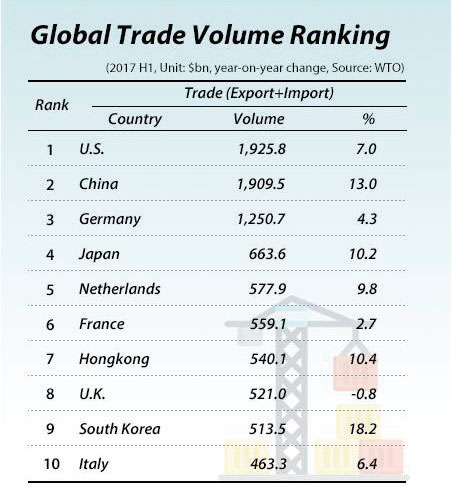
Korea dropped two notches to 8th place in export volume last year, with outbound shipments falling almost 6 percent to $495.5 billion. Korea fell behind Hong Kong and France.

This was the second annual decrease in a row, following an 8 percent dip in 2015, according to the Ministry of Trade, Industry and Energy.

The last time Korea experienced a second consecutive drop in exports was in 1957-1958 when they fell 9.7 percent and 25.9 percent, respectively.

Global trade among 71 economies also fell for two consecutive years. In 2016, global trade volume was $29.7 trillion, down 2.7 percent, following an 11.8 percent drop in 2015, the WTO noted. The lowest recorded trade figure worldwide was in 2010 when it was $28.2 trillion. The world economy fell for three years in a row from 1981-1983 following the second oil crisis in the late 1970s. The global slowdown has weighed on Korea’s export ranking, which fell from 6th among 71 countries in 2015. In 2009, Korea ranked 8th.

Although there are signs of the global economy recovering led by the United States, Korean exports are likely to face a slowdown in the latter half of this year amid inflation and protectionism.

Korean goods are increasingly exposed to risks associated with China’s diplomatic row with Korea over the U.S. Terminal High Altitude Area Defense, as well as the possibility of the United States designating the country as a currency manipulator this April, in line with the U.S. policy for a weaker dollar to support its exports.

“There is a chance that Korean exports will slow down in the latter half of this year more than the first half due to the trend of protectionism and uncertainties over the value of the won against the U.S. dollar,” said LG Economic Research Institute researcher Kang Jung-gu.

korean-machinery.com | Blog Magazine of korean-machinery, brands and Goods

Korean economy faces higher trade barriers

https://korean-machinery.com///inquiry President-elect Donald Trump is expected to deal an enormous blow to Korea which is heavily reliant on exports as he has vowed to strengthen trade barriers.

Youn Woo-jin, a senior researcher at the Korea Institute for Industrial Economics and Trade, said that the result of the U.S. election will adversely affect Korea’s already faltering exports on increasing risks of a slowing economy there as well as aggressive protectionism.

President-elect Trump has been pledging strong protectionism, which even most of his fellow party members criticized as populism.

“Trump has been moving away from the Republican Party, which has been a traditional guardian of free trade,” Youn said.

He pointed out that Trump had been vowing to adopt far-fetched protectionist measures, such as a withdrawal from negotiations over the Trans-Pacific Partnership, the renegotiation of the North American Free Trade Agreement, and high tariffs on imports from Mexico and China. Trump has also denounced the Korea-U.S. Free Trade Agreement (FTA) as a “job killing” deal, leading to speculation that his victory will lead to renegotiations or a complete scrapping of the deal.

Youn, however, said that such pledges are “little likely to be realized as there should be cooperation from Congress, as well as when taking into account the huge impact this will have on the global economy.” The Korea Trade-Investment Promotion Agency (KOTRA), meanwhile, expects Trump will demand a renegotiation of the Korea-U.S. FTA, on top of strong pressure such as antidumping and countervailing duties.

“Even if the U.S. Congress opposes these moves, Trump may be able to scrap the FTA or levy high tariffs on certain countries, with the authority endowed to the president,” said Yun Won-sok, executive vice president for business information and trade at KOTRA, pointing out that the diverse trade related laws give considerable authority to the president.

However, he added that trade with Korea may have less priority in Trump’s agenda as he has been more aggressively criticizing China and Mexico.

He has pledged levying a 45 percent tariff on Chinese products and levying a 35 percent tariff on Mexicanproduced cars.


A trade war with China will also weigh on the Korean economy which has been exporting components and materials to China. The hard-landing of the Chinese economy also means that Korea’s biggest export market will be diminished.

As other countries will also retaliate against the United States, Trump is likely to trigger a protectionist trade war. This means the Korean economy, which has been heavily relying on exports, will be further pressured. Korea’s exports briefly rebounded in August following 19 months of falls, but they dipped again in September and October.

Youn also expects the U.S. economy to enter a recession with the trade war, with the economic growth rate projected to fall from 2.7 percent in 2016 to 0.3 percent in 2017, and to minus 0.1 percent in 2019. A recession in the United States in itself is also negative for Korean exporters.

However, some businesses may find bigger opportunities to advance into the U.S. market as Donald Trump has pledged massive infrastructure investment.

“Based on Trump’s public infrastructure policy, construction, communication, logistics and construction materials will likely see markets expanding,” Yun said.

Trump has also stressed opening the pharmaceutical market for higher efficiency of the U.S. public health system. Yun said this may be an opportunity for Korean pharmaceutical exporters as well.

korean-machinery.com | Blog Magazine of korean-machinery, brands and Goods