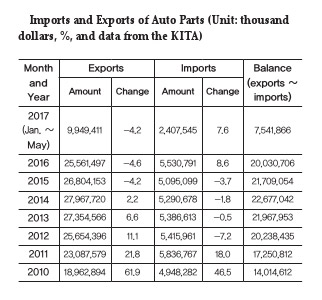
 As the imported car market grew and overseas sales of Korean cars slowed down, the nation’s trade surplus in the auto parts sector has been on a steady decline.
According to recent statistics released by the Korea International Trade Association (KITA), Korea’s trade surplus of automobile parts by the end of May this year stood at US$7.54 billion, a 7.5% drop from the same period of last year.
Exports of automotive parts this year were US$ 9.949 billion, down 4.2 percent from the previous year, while imports of automotive parts sat at US$ 2.408 billion, up 7.6 percent from last year.
In fact, Korea’s auto parts exports have been on a decline since peaking at US$ 27.96 billion in 2014. In 2015, exports of auto parts were US$ 26.84 billion, down 4.2 percent from the previous year. They contracted 4.6 percent in 2016.
On the other hand, imports of automobile parts have been on a sharp rise in recent years. Despite a drop of 3.7 percent from a year earlier to US$ 5.095 billion in 2015, and last year, imports of auto parts were US$ 5.53  billion, up 8.6 percent from a year earlier.
As a result, Korea’s trade surplus in the auto parts sector is decreasing year by year. The surplus hit a record high of US$ 22.67 billion in 2014 and slid to US$ 21.79 billion in 2015 and US$ 20.31 billion in 2016.
The surplus has dropped for the third consecutive year this year. If this trend holds, this year’s trade surplus is expected to fall below US$ 20 billion within six years since chalking up US$ 17,151 million in 2011.
On the other hand, Korea imports high-tech auto parts mainly from Japan, the USA, Germany and France among others. Emerging markets such as China, Mexico, and Romania export low-priced auto parts to Korea.
korean-machinery.com | Blog Magazine of korean-machinery, brands and Goods
 including the USA, Germany, Singapore, Thailand, etc. were confirmed for participation.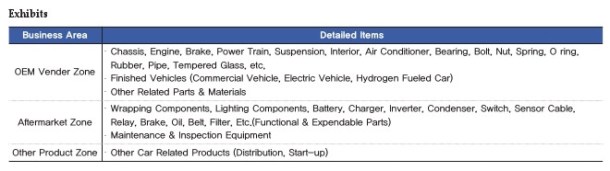

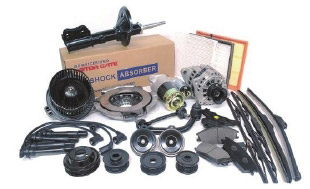 The company’s compressor is a core precision product working like a human heart in the air conditioner system. It is operated by power of an automobile engine. It repeats a process of inhaling, compressing and circulating a refrigerant. It compresses a refrigerant in low temperature, low pressure gaseous form generated from an evaporator and changes it into high temperature, high pressure gaseous form, before sending it to a condenser. There are stationary, variable (outside/inside) and motor type compressors.
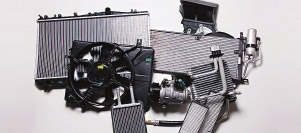 cores, hoses & pipes, HVAC units, air conditioner systems and various air conditioner components for vehicles. Recently, we are adjusting to diversification of export markets.
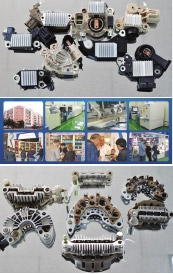 Alternator regulators apply for 12V and 24V charging systems with a wide range of operating temperatures, from -45°C to +135°C. A self-compensating thermal circuit with custom setting voltage as well as custom package design is available. They are multi-functional with HIC & ASVR types, including LRC function, faulty warning and protection.
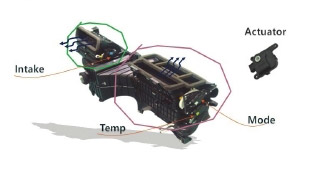 abroad, the company’s damper actuator takes the most upper location among various kinds of its products that are ready to be sold. It is because of its comparatively superior merits to allure more potential buyers than the remaining players. It controls dampers of heater units and blower units at HVAC system of vehicle to control temperature, air direction and air circulation inside of vehicles. Mode and temp actuators are installed in the heater unit, and an intake actuator is installed in the blower unit. The intake actuator is designed to control incoming wind direction to move damper or circulating inside air. The mode actuator is to control incoming wind direction in 5 modes-vent, b/l, foot, def/foot and def. The temp actuator is used for inside temperature adjustment (air con/heater).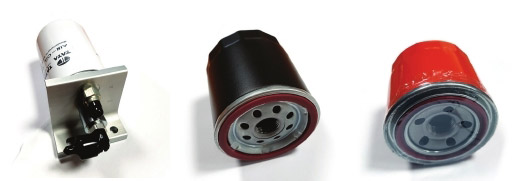
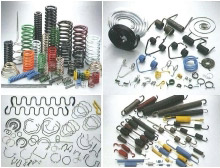 used after compression springs. Wire spring can be designed in complex and various forms, customized by designers, and is used in various forms such as linking lever, pin, clamp and clip.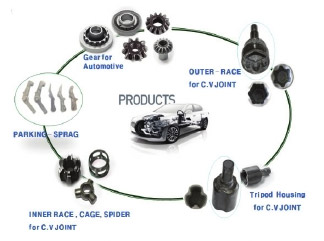



 Korean-Machinery.com