 South Korea’s top machinery manufacturer Doosan Infracore Co. will supply bus engines for Vietnamese commercial vehicle makers as part of efforts to ride on the burgeoning Vietnamese bus market.
Doosan Infracore recently showcased a compressed natural gas-powered bus at an event celebrating its first supply batch of bus engines to Vietnam-based Saigon Transportation Mechanical Corp (SAMCO) in Ho Chi Minh City, Vietnam. The company plans to ship nearly 500 bus engines and bare-bone chassis for four commercial vehicle makers including SAMCO and 1-5 Auto JSC in Vietnam.
The Vietnamese bus market has been growing rapidly in recent years. According to Vietnamese auto manufacturers’ association, the number of buses sold in Vietnam last year increased 20 percent to 14,770 units from 12,178 units in the previous year. The large-sized bus market, which Doosan Infracore seeks to win with its 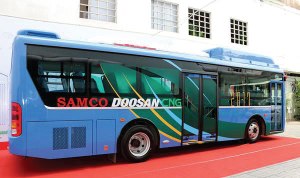 bus engines doubled to 6,214 units last year from 3,027 in 2015.
The Korean machinery maker plans to set up auto repair centers and provide trainings for mechanics in Vietnam with a goal to expand out to other Southeast Asian bus market.
It also aims to sell 500 units of bus engines in Indonesia that is scheduled to hold the Asian Games 2018.
korean-machinery.com | Blog Magazine of korean-machinery, brands and Goods
 The distribution center of Amazon, the largest distribution company in the world, employs more than 45,000 logistics robots and saves significantly in matters of costs as well as time. However, these logistics robots are only responsible for transfer functions, therefore, still requiring human-robot collaboration model and relying on humans for picking. As a result, the system cannot operate 24 hours a day.
 The multi-complex will be aimed at providing visitors the opportunity to experience various environmental-friendly energy facilities and eventually turning into a tourist attraction.