
The World’s First Byproduct Hydrogen-fueled Power Plant

https://korean-machinery.com///inquiry

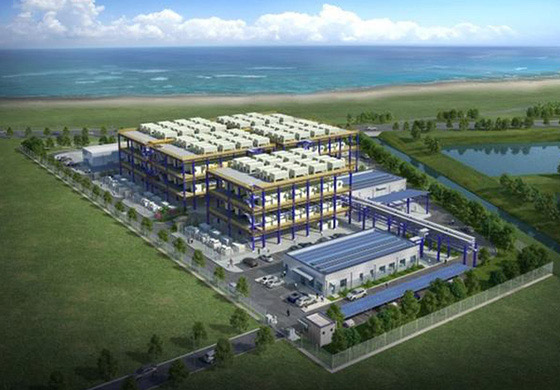
South Korea’s Doosan Corp. and Hanwha Energy Corp. will create the world’s first power generator of 50 megawatt fueled by byproduct hydrogen as energy source in Seosan, South Chungcheong Province, in joint venture, as the country seeks energy sources beyond the traditional nuclear and fossil fuels.


The 469 billion won ($415.7 million) project recently announced by the two companies will involve building a 50-megawatt byproduct hydrogen fuel cell power plant on a facility site managed by Hanwha Total Petrochemical Co. at Daesan Industrial Complex in Seosan, South Chungcheong Province, by 2020. The two companies will set up a special purpose company called Daesan Green Energy for the project with investment also from Korea East-West Power Corporation and SK Securities Co.
The power plant will be the world’s first of its kind using byproduct hydrogen as fuel, the companies accounced. Byproduct hydrogen fuel cell uses hydrogen created as byproduct in various chemical processes as energy source. Doosan will supply 114 fuel cell units and be responsible for long-term service once the plant is completed. Doosan developed byproduct hydrogen fuel cell units based on home-grown technology last year with plans to supply them to hydrogen power plants starting in the fourth quarter of this year.
Once completed in June 2020, the fuel cell power plant will be capable of producing 400,000 megawatthour electricity annually, which is enough to supply power to about 170,000 households in the Seosan area.
A spokesperson for Doosan said that the latest project is significant in that it is its largest in terms of power capacity since it advanced into fuel cell business. He added that it would also be an opportunity for Korea to gain a technological competitive edge over others and take the lead in the global byproduct hydrogen fuel cell market that is still in its early development stage.
Meanwhile, a spokesperson for Hanwha Energy, which will own a 49 percent share in Daesan Green Energy, also said that the construction of the latest hydrogen fuel cell power plant will allow it to contribute to expanding Korea’s renewable energy industry and boost the regional economy. It will also strive to launch other renewable energy projects based on its accumulated experience. (Source: KITA)
korean-machinery.com | Blog Magazine of korean-machinery, brands and Goods
Korea’s Consumer Sentiment Chills by Fastest Pace since Impeachment

https://korean-machinery.com///inquiryAccording to data recently released by the Bank of Korea, South Korea’s composite consumer sentiment index (CCSI) for June deteriorated 2.4 percentage points from the May reading to 105.5, lowest since 100.8 in April last year.
The last time consumer sentiment soured so abruptly was in November 2016 following the legislative impeachment on sitting Korean president Park Geun-hye.
The index just managed to stay above the 100-threshold. A number beneath it means consumers are more negative than positive about the economy. After deteriorating for five months in a row, sentiment briefly improved last month amid expectations for eased geopolitical risk and revived inter-Korean economic ventures following the South-North Korea summit.
The indices measuring present sentiment for the economic conditions and outlook for the economy in coming months fell 5 basis points respectively to 84 and 96.
The worsening sentiment, which can further dampspending and domestic demand, and job data, as well as uneasiness on the external front due to escalated trade conflicts among economy majors of the U.S., China, and Europe, will likely to put the Bank of Korea in a greater bind. The bank has stayed pat on its rate at 1.50 percent despite increases in the U.S. Federal Reserve but cannot put off tightening any longer due to widening gap. The survey for this month was conducted from June 11 to June 18 on 2,200 households across the country, of which 1,958 households responded. (Source:KITA)

korean-machinery.com | Blog Magazine of korean-machinery, brands and Goods

Hankook Tire to Take Over ‘Modle Solution’ for KRW68.6 billion

https://korean-machinery.com///inquiryHankook Tire recently announced that they will acquire 75% stakes of ‘Model Solution Ltd.’, an advanced digital prototype solution company, for KRW68.6 billion.
Hankook Tire will incorporate Model Solution into its affiliate by acquiring 75% total of its shares including a 51% stake on ‘Laird,’ a UK electronics company, and a 24% stake on Crescendo Equity Partners, a global private equity firm.
Model Solution, established in 1993, is a company that designs and manufacturers prototypes and molds of new products grafted to cutting-edge technological prowess such as electronic products and medical devices including the state-of the-art IT equipment and, beginning with the prototype solution service in 2007, now has about 420 global clients.
In particular, Model Solutions has cutting-edge technological prowess that can provide services ranging from design to prototype manufacturing, including the best design and execution power in the industry. Based on various attempts at high-tech technology such as 3D printing, the company is also leading the technological expertise of the prototype industry.
This time, the acquisition was carried over as part of strengthening investments in future promising technologies and securing next-generation growth engines through the M&A of the company with state-ofthe- art technology based on connectivity with high technology that Hankook Tire is aiming for.

korean-machinery.com | Blog Magazine of korean-machinery, brands and Goods

Kumho Tire to Supply Tires to Volkswagen Atlas

https://korean-machinery.com///inquiryKumho Tire Co., Ltd. recently announced that it will supply OE (tires for new cars) for the 2018 new models of Atlas, Volkswagen’s large SUV.
The Volkswagen Group, ranked as the first place in global sales of complete vehicles in 2017, is a global leading automaker having famous brands of Volkswagen, Audi, Lamborghini and Porsche.
Atlas is the first full-size seven-seater SUV developed by Volkswagen to target the North American market, where big SUVs such as family vans and pickup trucks are popular, and it has the largest body among Volkswagen SUVs ever produced.
In addition, equipped with VR6 3.6L gasoline engine, Atlas boasts of a maximum output of 280 horsepower and has received the Five-star Safety Rating in the highest safety test conducted by the United States National Highway Traffic Safety Administration (NHTSA).
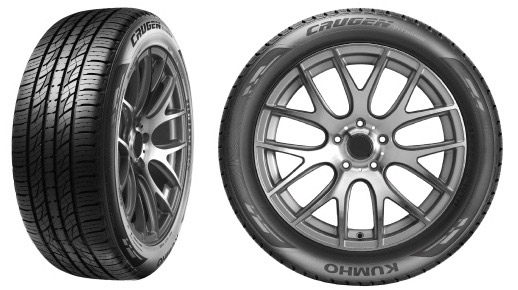
The 2018 Atlas will be equipped with Crugen Premium KL33, Kumho’s best-selling tire exclusively for SUV.
The Crugen series of Kumho Tire was developed in line with the emergence of urban SUVs. Perfectly equipped with such functions as handling, braking, stability in high-speed driving, etc. on the road to realize sports performance optimized for the high performance SUV, Crugen series is well known in the overseas market as well as in South Korea as the tire exclusively for SUV.
In particular, Crugen Premium, the standard of SUV tires, is the product that enables the drivers to feel quietness and a comfortable ride in a luxury sedan, even in SUVs. The upgraded silica compound material has improved fuel efficiency and the optimized platform has been applied to ensure the quality and quietness of the ride.


Such functions as the tread pattern, designed to improve driving stability and reduce abrasion, inner block semi-knurling (punching block surfaces to prevent slipping), 3D block, and four wide drainage grooves make stable driving possible even in the rain.
The Volkswagen Atlas that has been manufactured at the Chattanooga plant in Tennessee, USA since November 2016 is sold to Latin America, the Middle East and Russia, including North America. Tires for Atlas are produced in Kumho’s Gwangju Plant.
Mr. Jo Man-sik, senior vice president in charge of product development 1 of Kumho Tire Co., Ltd. said, “As the OE supply to 2018 Atlas this time means that Kumho’s products are supplied in large quantities as the main specifications, we can say that the product quality and our technological prowess have been recognized. Kumho Tires will strive to develop and supply tires exclusively for SUV so that we can satisfy both customers and drivers in response to the rapidly increasing demand for SUVs.”

korean-machinery.com | Blog Magazine of korean-machinery, brands and Goods

Overall Growth of Five Korean Automakers in Domestic and Overseas Auto Markets

https://korean-machinery.com///inquiry

During the month of March 2018, five Korean automakers sold a total of 719,003 units in domestic and overseas markets, which was up 0.7% from the previous year, and up 25.8% from the previous month.


According to sales figures of five Korean automakers on March 2, domestic sales in March 2018 decreased by 4.4% from March last year to 139,932 due to the massive crisis of GM Korea, which is about to close its Gunsan factory, and Renault Samsung Motors currently experiencing a slump in sales. On the other hand, Ssangyong Motor and Kia Motors maintained a similar level of sales as in the previous year. Hyundai Motor has grown significantly in size with the blessing of the good sales of its new models.
Hyundai Motor grew 6.0% year-on-year with sales of 67,577 vehicles in March alone in the domestic market. Sales of the newly released Santa Fe model recorded a 13,05% increase from last year to 13,076 units and became the best seller of the year. The company explained that the number of Santa Fe’s stacked contracts surpassed 32,000 units, with as many as 13,000 units standing by. Grandeur also sold over 10,000 units, a decrease of 20.7% compared with the previous year, but 16,928 cars were delivered to consumers. It was followed by Avante with 5,928, down 15.3 % from March last year, and Sonata with 5,685, down 25,0 %. In the same period, Tucson recorded a decrease of 6.9% to 3,390 units, while Kona sold 4,098 units. Starex and Porter achieved sales of 4,540 and 8,881 units respectively.
The Genesis brand was up 7.4% year-on-year to 5,843. The G80 decreased by 10.6% to 3,618 units, while the EQ900 fell 28.8% to 992 units. The G70 sold 1,233 units leading the sales momentum.
Kia Motors sold 48,540 units, up 1.9% from March 2017. The new K3, which was introduced at the end of last February, as well as Ray, and the partially remodeled K5 changes led to the growth. K7 and Sorento have enjoyed steady popularity as well. In particular, the K3 sold 5,085 units, up 95.4% from the previous year, while the remodeled K5 sold 5,043 units, up 37.3%. In the same period, Ray increased 41.0% to 2,713, while Sorento increased 10.1% to 6,965. In addition, K7 decreased by 39.2% to 3,309, and Carnival fell by 12.4% to 5,708. Stonic, a small SUV, sold 1,625 units, Niro with 1,982 and Sportage with 3,147.
Ssangyong Motor posted sales of 9,243 units in the Korean market in March, up 0.2% from the previous year. Since its release, Rexton Sports has recorded cumulative contracts of more than 20,000 units, selling 3,007 units, and has achieved record monthly sales since 2004 (3,180 units for Musso Sports in April). As a result, the company plans to increase its production volume by changing the work patterns such as consecutive double shifts on three assembly lines that will produce Rexton Sports starting from this month. Tivoli sold 4,121 units, down 24.0% from a year earlier, while G4 Rexton sold 1,541 units, up 410.3% along with 288 Korando Cs and 286 Korando Turismos.
Renault Samsung sold 7,800 units, down 25.8 % year on year. SM6 dropped to 2,767 units, 42.9% from the previous year, and QM6 dropped 6.9% to 2,254 units. QM3 fell by 70.5% to 480 units, SM7 dropped by 20.5% to 465 units, while SM3 decreased by 25.2% to 397 units. However, SM5 grew 114.9% over the same period and delivered 950 units to consumers. SM3 Z.E., an electric model released from this year, sold 88 units while Twizy sold 399 units
GM Korea sold 6,272 units in the domestic market in March, plunging 57.6% from a year earlier but up 8.1% from February, when the shock hit Gunsan City in North Jeolla Province, Korea. This improvement was presumed to be the result of properly targeting consumers who hesitate to buy through the Chevy Promise program, which extends the warranty period to guarantee the used car values. Spark jumped 5.0% MoM to 2,518 units, and Cruise rose by 141.9% to 566 units. Captive delivered 138 units to customers, up 56.8% from February, while Orlando increased 20.0% to 438. However, Malibu dropped 21.7% to 909 units and Trax dropped 4.3% to 707 units. Damas and Labo sold only 285 and 351 units respectively. With more than 5,000 units pre-contracted, Bolt EVs started a full-scale delivery with the sales of 160 units in March.
Meanwhile, exports of five Korean auto makers in March 2018 totaled 579,571, an increase of 2.0% from March last year, showing growth of 24.4% from the previous month. Hyundai Motor’s exports grew by 0.8 % to 329,464 units, while Kia Motors exported 193,734 units, up 3.7 %. Renault Samsung posted a 30.4 % increase to 19,259 units. In the same period, GM Korea dropped 3.0% to 34,988, while Ssangyong Motor dropped 43.5% to 2,126.

korean-machinery.com | Blog Magazine of korean-machinery, brands and Goods

Robot Industry, the Biggest Beneficiary of the 4th Industrial Revolution

https://korean-machinery.com///inquiryThe industrial robot parts produced in China and education services in China and Japan are emerging as the most promising in each industry. In order for Korean robot companies to expand into the global market, it is necessary to seek strategies to enter diverse markets such as joint technological development and investment with local companies by targeting core technologies and markets of promising fields.
In regard to the robot industry, which is emerging as the convergence of traditional manufacturing technologies and information and communications technology (ICT) for the future and the biggest beneficiary of the 4th Industrial Revolution, the global market conditions and prospects was presented along with analysis of the latest technological trend, while local companies were offered a substantive roadmap to expand into foreign markets.
According to the report, Global Robot Industry Market Trends and Strategies to Make Inroads, recently published it is essential to secure technological competitiveness in smart factories, machine learning, cooperative robots, artificial intelligence, etc. for invigoration of expansion into Asian global markets based on robust domestic demand with the number of sales.
Demand for industrial robots is on the rise due to the global companies’ efforts to modernize and automatize production facilities, improve energy efficiency, utilize new materials, and improve product quality. According to the International Federation of Robotics (IFR), a 15 percent annual growth rate is expected by 2020.
China is currently the world’s largest market with 30% market share, but its robot density is significantly lower than that of advanced countries, which leaves its potential still high. The robot sales in China are expected to increase by 140% by 2020. In particular, Korean companies have high potential to export to China in terms of core components such as controllers and speed reducers, which are difficult to produce in China. As of 2016, exports of robot parts to China amounted to KRW 36 billion, up 74% from the previous year.
Even in the advanced markets such as the USA and France, where there are no companies within the global top 10, Korean products have a good reputation for their cost-effectiveness and installation technology. Eastern Europe, India, Thailand, and Brazil are also emerging as new sources of demand despite relatively small market sizes at present, anticipating an annual growth of more than 20% by 2020. However, there is only a limited potential for entering into Japan and Germany where robotic technology for manufacturing is the most advanced.
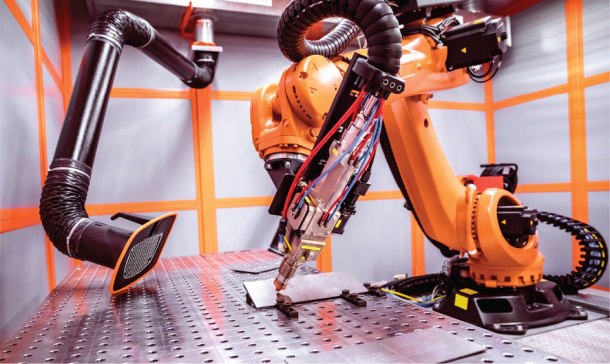
Although it is not easy for Korean companies to narrow the technological gaps against leading global companies in the conventional robot industry, it is necessary to secure technologies related to smart factories and cooperative robots that are currently in the limelight.
Siemens and Adidas have completed the construction of a smart factory equipped with full-blown automation and intelligentization throughout the entire manufacturing processes based on ICT, and are accelerating technological development in the USA, China, and Japan. As machine learning is an essential technology for materializing efficient smart factories, Yaskawa Electric Corporation, a Japanese manufacturer of servos, motion controllers, AC motor drives, switches and industrial robots, has introduced a machine learning software that is capable of mastering a selected craftsmanship within two hours. As for cooperative robots for which the market growth is in full swing from US$100 million in 2015 to US$1 billion in 2020, it is necessary to preempt core technologies such as lightweighting and robot mobile technologies.
It is also expected that the robots market for global services will grow significantly. IFR expects service robots for special purposes and personal services such as housekeeping to grow by 20-25%, 30-35%, and 20-25% each year by 2020. In particular, it anticipates an explosive increase in demand for logistics robots including AGV, an essential item for smart factories, medical robots for surgery and treatments, and promotional robots to provide customers with guides or information.
Held last January in Las Vegas, United States, CES 2018 was dominated by robots equipped with AI. Aibo, a robotic pet produced by Sony, and Sophia, a humanoid robot developed by Hanson Robotics, and some others demonstrated great adaptation in everyday human life through dialogues, questions and answers, and games with human participants. Also, visitors flowed in and out all day at the booths exhibiting displaying housekeeping and entertainment robots.

The most promising field for Korean companies to expand is the educational robots market where global companies have yet to enter. In particular, Korean company’s technological prowess is evaluated positively in the countries with high demand for English education such as China and Japan. It is necessary, however, to develop technologies such as facial recognition for user verification, emotion recognition, speech recognition, and big data in order to ensure product differentiation and competitiveness.
In terms of strategies to make inroads into global markets, it is desirable to reduce the risks involved with overseas expansion by cooperating with local venture capital, accelerators, and start-ups. Meanwhile, American venture capitals’ investments in the U.S. robotics industry are increasing rapidly, while Japan is actively supporting alliances with overseas start-ups and accelerators for the advancement of service robots at the government level. In the case of Chinese companies, the demand for technological cooperation to develop sensors and artificial intelligence is high, thereby making it easy to promote joint research and development programs.
“The robots industry, which is experiencing a rapid increase in global demand, will become a representative food business in the era of the 4th Industrial Revolution,” said Yoon Won-seok, an executive of the Korea Trade-Investment Promotion Agency (KOTRA). “Korean companies need to seek global cooperation such as joint R&D with robot technology leaders and exchange of technology and investment. We will be able to enhance our competitiveness in the global robots market by seizing initiative of future-oriented core technologies such as cooperative robots and AI technologies based on our strengths in IT and manufacturing technology.”

korean-machinery.com | Blog Magazine of korean-machinery, brands and Goods

Staying Ahead of the Competition in the Robot Industry through Cooperation and Service Robots

https://korean-machinery.com///inquiryThe Korean government made a full-fledged start to advance the robot industry. According to the “New Government’s Industrial Policy Direction” announced in December last year, the Ministry of Trade, Industry and Energy (MOTIE) recently held the Intelligent Robot Industry Development Strategy Conference at the Korea Institute for Robot Industry Advancement to discuss development plans for the robot industry.
While the world’s leading companies are competitively launching high-tech robots equipped with artificial intelligence, and the market for cooperative robots design to work with humans in industrial fields, is expected to grow rapidly from US$200 million in 2016 to JPY$ 3.24 billion in 2022. The United States and Japan invested US$22.5 million and JP¥ 29.41 billion in 2016, respectively. With the growing demand for service robots to improve the quality of life due to the increase of the elderly population and the demand for personalized service, the International Federation of Robotics (IFR) expects an average annual growth rate of 10% with US$ 14.9 billion in 2020.
On the other hand, the growth of the Korean robot industry is centered on large companies manufacturing automobiles and electronic appliances. This resulted in more than three times the difference in manufacture robot production with KRW 2.67 trillion and service robot production with KRW 770.4 billion in 2016, thus posing a concern that it will be fixed as manufactureroriented.
Therefore, the Ministry of Trade, Industry and Energy (MOTIE) announced a plan in the conference to create leading markets and support growth centered on cooperative and service robots, which are expected to lead the global market in the future.
First, the companies equipped with smart factory construction and root companies will be provided with cooperative robots to improve the productivity of small and medium-sized manufacturers suffering from the burden with minimum wage and manpower shortage. In addition, the commercialization of service robots is planned for the five promising areas including smart home, medical, rehabilitation, disaster and safety, unmanned transportation, and agricultural robots.
In order to strengthen the innovation capability, MOTIE will concentrate its support on research and development of the three major robot parts including operation, sensing, and control, for the robot-mounted platform and the CNC control machine standard model, with a plan to specialize the research and support organizations by dividing them into three regions. This growth support measures include preparing cooperative robots safety guidelines, improving regulations that may impede the proliferation of robots, and expanding new jobs related to robot service.
Moon Seung-Wook, Director-General of MOTIE, urges the industry, academia, and research field to work together to contribute to the global competitiveness of the robot industry and to the creation of jobs for youths. The government also emphasized efforts to create tangible outcome through speedy promotion of development strategy regarding the intelligent robot industry.

korean-machinery.com | Blog Magazine of korean-machinery, brands and Goods

KEPCO Plays a Catalytic Role in Exporting Korean Power Equipment to Cambodia

https://korean-machinery.com///inquiry

KEPCO Signs MOU for an Export Demonstration Project with Local Companies in Cambodia and Domestic SMEs.

Korea Electric Power Corporation (KEPCO) has served as a stepping stone for advancing into the market for power equipment in Cambodia in cooperation with domestic SMEs.
Recently in Cambodia, KEPCO signed an MOU for an export demonstration project with Best Partner Co. (BPC), a Cambodian power supply company, and Icel E&C, a demonstration project agency, as a pilot project to export Korean electric equipment to Cambodia.
The Export Demonstration Project is designed to install the quality products and systems developed for KEPCO and SMEs through coordinated R&D and demonstrate their suitability for the local environment to win export contracts.
This export demonstration project is a stand-alone microgrid (MG) power supply solution that utilizes solar power and batteries simultaneously based on the energy self-sufficient island project that KEPCO has promoted for many years. Starting with the demonstration project of the Cambodia stand-alone microgrid system, it is expected that an export contract worth about US$4.6 million will be signed for installation in 100 locations in Cambodia in 2019 and beyond.
Icel E&C is scheduled to install three independent MG systems consisting of 16 kW photovoltaic system and 2600AH batteries for power supplies used in mobile phone base stations in Cambodia.
Hwang Kwang-soo, Director- General of the Export Cooperation Department at KEPCO, attended the MOU signing and explained, “We hope that this project will improve the overall performance of electric power facilities in power stations in Cambodia by using high-quality Korean equipment. I also wish Cambodia and Korea have a long-lasting partnership.”
“KEPCO’s power technology is the best in the world,” remarked Paul Sabandi, president of BPC in Cambodia, adding, “We hope that KEPCO and Cambodia will maintain continuous exchange and cooperation through this project.”
Starting with this MOU, KEPCO is expecting to sign an agreement for export demonstration projects with Tenaga Nasional Berhad (TNB), the only electric utility company in Malaysia and also the largest publiclylisted power company in Southeast Asia, and Indonesia Electric Power Corporation Perusahaan Listrik Negara (PLN), an Indonesian government-owned corporation providing electricity distribution.

korean-machinery.com | Blog Magazine of korean-machinery, brands and Goods

Deep Learning-Based Artificial Intelligence Changes Autonomous Vehicle Technology Landscape

https://korean-machinery.com///inquiryUntil recently, only a small number of companies with expertise in high-priced specialized sensors and the automobile industry could implement autonomous navigation technology. High technological and financial barriers formerly allowed only ICT giants and a small number of companies in the automobile industry with capabilities for long-term investment and technology development to take the initiative in the development of autonomous driving technology.

In fact, a single car used in the early days of Google’s development of autonomous driving was priced at about 170 million won. The price of a LIDAR sensor used as the core sensor of the car stood at 80 million won. In addition, about 170 staff members brought in mainly from automakers spent more than four years in R&D to develop a self-driving vehicle.

However, these high technological barriers are being broken down by artificial intelligence, especially deep learning. Companies that implement self-driving technology using deep- learning have been emerging rapidly over the past two years, particularly in Silicon Valley.

Unlike previous autonomous driving technology, which was implemented by automobile experts using a rule-based approach, these companies implement autonomous driving technology in a process as if people improved driving skills by repeating drives based on deep learning. A small number of developers are implementing autonomous driving technology in a very short time by using low-cost, general-purpose sensors rather than expensive ones.

In addition, the rapidly evolving artificial intelligence technology is expected to be applied to autonomous navigation and will accelerate the revolutionary change of technology competition in the future. Leading research institutes in the field of autonomous navigation are already conducting studies to integrate the latest research in artificial intelligence such as reinforcement learning, relational networks, and transferring intelligence into the development of autonomous navigation technology.

Especially, as these researches realize a process where artificial intelligence learns, reasons, and forecasts in a way similar to that of human beings, when applied to autonomous driving technology, it will be possible to develop a car that runs by thinking and judging like a human being.

In academia and the start-up world, autonomous driving technologies based on deep learning have already been introduced one after another. With innovative cases taking place every year, experts in the fields of artificial intelligence and deep learning, not experts in the automotive industry, are integrating their research into the automotive field and presenting their technology.

In particular, these companies are announcing their technologies as open sources and they are accelerating technology through researchers’ participation and competition. This method differs greatly from technology competition among major companies in the automobile industry which have developed technology through the development and internalization of their own technology.

Automakers that have adhered to existing methods are also responding to the new technology paradigm by rapidly securing their deep-learning capabilities. Major automakers with OEM systems such as Daimler, VW, and Toyota have been rapidly introducing external technologies by investing in and acquiring start-ups related to deep learning since 2016. Internally, they have also invested heavily in developing their own technologies by setting up AI-specialized research centers. In particular, GM and Ford are responding to technological competition where they have been lagging behind their rivals by acquiring or investing in self driving start-ups based on deep learning with more than one trillion won in investments each.

“The core of autonomous technology competition has already started to move to deep learning. Artificial intelligence experts in the field of deep learning are rapidly implementing autonomous navigation technology with low-cost general-purpose sensors. Most companies are also developing autonomous navigation technology based on deep learning and competition in the automobile industry is expected to focus on securing competence in artificial intelligence field and securing driving data in the future,” said Lee Seung-hoon, a researcher at the LG Economic Research Institute. “This is because the technological quality of AI based on machine learning such as deep learning will be determined by data collected more diverse driving environments and the utilization of learning processes.”

In addition, he said, “Companies such as comma.ai and Tesla that have already recognized the importance of securing actual driving data have already gathered driving data from millions to hundreds of millions of kilometers and are using them in self driving learning processes. It is expected that when the autonomous driving market is full-fledged, technology gaps between companies with such data and advanced intelligence and those without them in the beginning of the market will be very large and it will be a big challenge for latecomers to narrow such gaps,” Lee added.

korean-machinery.com | Blog Magazine of korean-machinery, brands and Goods

New Super-Plastic Steel Material

https://korean-machinery.com///inquiry

Expected to Be Applied to Machining Hard-to-Manufacture Parts of Complex Shapes

The National Research Foundation of Korea (KRF) recently announced that a research team led by professor Lee Young-kook (Yonsei University) developed a new super-plastic steel material that is economical and relatively easy to produce.
Recently, shapes of components used in various industrial fields such as automobiles and aircraft have become increasingly complicated, and it is necessary to mold and assemble such hard-to-machine components of complicated shapes. In order to overcome these disadvantages, much attention is being paid to super-plastic steel materials and moldings that can create parts of complex shapes through a single process.

So far, various super-plastic materials have been developed but are difficult to commercialize. Zinc and aluminum alloys have low strength after molding. Raw materials for nickel and titanium alloys and stainless steels are expensive, and high carbon steel has a problem of a complicated manufacturing process.

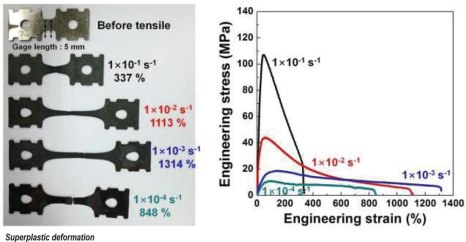
The research team successfully developed an ultra-fine, medium manganese steel material with an elongation rate of up to 1341%, using medium manganese steel actively studied recently.

The researchers used medium manganese steel with manganese (6.6%) and aluminum (2.3%). This alloy can produce fine grains which are important prerequisites for a super-plasticity phenomenon due to a difference in the distribution of manganese and aluminum when undergoing heat treatment after a rolling process.

In addition, the research team conducted a tensile test at a temperature range of 650°C to 900°C, and found that the elongation rate was up to 1,314% at 850°C and rose over 300% at 650°C, a relatively low temperature.

The super-plastic medium steel material developed in this study is economical compared to conventional super-plastic stainless steel and high carbon steels because small amounts of manganese and aluminum go into the material and can be manufactured using a conventional steelmaking process. In particular, medium manganese steel has an advantage of easily forming crystal grains of several hundred micrometers to several micrometers, which are important for super-plasticity.

“We anticipated that this research will make it easier for various industries to manufacture parts of complex shapes difficult to mold, while requiring high strength by using new super-plasticity steel materials with excellent cost-cutting effects,” Professor Lee said.

korean-machinery.com | Blog Magazine of korean-machinery, brands and Goods