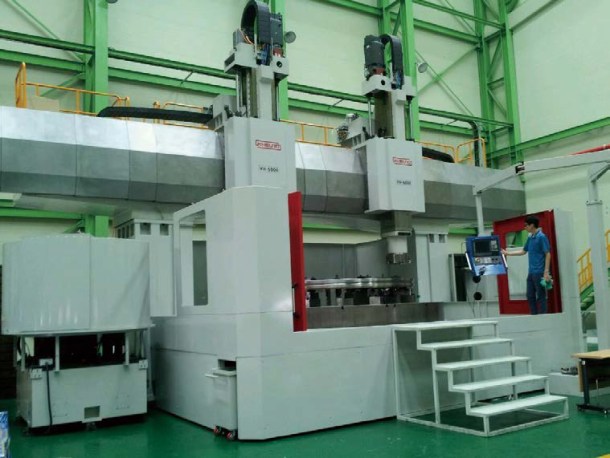
Large-sized multi-tasking vertical lathe for windmill parts

Technology overview: Just recently a large-sized multi-tasking vertical lathe has been required at the parts machining market of the wind power generator, along with the vertical lathe having been conceived as the device exclusively for the parts machining of the large-sized wind power generator. Although, until now, https://korean-machinery.com///inquirythe parts of the wind power generator have been machined using large-sized machining center for vessel, aircraft and construction equipment, more and more specialized large-sized multi-tasking machining systems tend to be developed targeting the wind power generator market which will develop rapidly from now on. However, the Yaw & Pitch bearing machining equipment for the wind power generator is the field under examination in Korea without any full-fledged production, and all of the equipment used domestically are imported from overseas countries. The high-speed, high-precision and hydrostatic rotary table which is the core fundamental technology as the typical high-value equipment among large-sized machining systems in the future and the hard-turning technology of the high-hardness materials on the lathe with the high-stiffness ram are urgently needed to be developed in Korea for advancement of the large-sized vertical lathe. It is expected that with the development of this technology, the fundamental technology will be secured for localization of the multi-tasking vertical lathe for machining the Yaw & Pitch bearing of the wind power generator entirely dependent on import, the foundation for developing various high-value large-sized machining system by overcoming the technical dependencies will be prepared, and the economical effect will be doubled, such as import substitution effect, targeting the overseas wind power generator markets and technical ripple effect on the development of similar high-value machining system.

Industrialization: We have secured the core fundamental technology of the multi-tasking vertical lathe for machining the Yaw & Pitch bearing of the wind power generator previously entirely dependent on import. We autonomously developed the machine tool structure optimization technology, having applied the techniques of core module design and analyzation, and the topology and dimensional optimization method in order to localize the parts machining system for the wind power generator monopolized by the advanced countries. Also we have secured the core technology through the autonomous development of large hydrostatic rotary table and performance verification, and have achieved the preoccupancy effect of the high-value market for the parts machining of the wind power generator by developing the commercialization model. At present, there are active test cuttings by the overseas buyers and customers visit us frequently. We have already concluded three Memorandums of Understanding(MOUs).
Untitled-21

Problem-solving in industrialization: For the purpose of localizing the core technology of the multi-tasking vertical lathe for machining the Yaw & Pitch bearing for the wind power generator, as a result of having performed the structural analysis taking the case of machining in the worst conditions through technical exchange and cooperation with the government-funded research institutes, we have confirmed its structural safety. After having checked the occurrence of distortion at the cross rail of the initial model, we performed the topology optimization and the dimensional optimization in order to reduce the distortion. As a result, we came to compensate and manufacture the cross rail by decreasing the displacement of the tool center point in comparison with the initial model.

Technology developer: Kiheung Machinery Co., Ltd. / +82-42-933-5500 / www.kiheung.com

korean-machinery.com | Blog Magazine of korean-machinery, brands and Goods

80kW traction motor and decelerator technology for C-segment electric vehicles

Technology overview: Unlike an internal combustion engine that is mainly operated by an engine, the powertrain of an electric vehicle is a system run by an electric motor with a decelerator using battery.

https://korean-machinery.com///inquiryThe powertrain of an electric vehicle consists of a driving mechanism that directly uses a motor’s torque to run wheels. Since it only uses battery as a power source, it is very important to develop high power output and high performance of traction motor and decelerator, and weight reduction technology. Once these are accomplished, it is possible to extend the vehicle miles traveled. In advanced countries, permanent magnet synchronous motor made of rare earth materials is generally used to achieve high performance and high power density. An acquirement of cost-competitiveness has been greatly attracted in automotive industry as the cost of rare earth materials has been on the rise.

In addition, it is very important to maximize the vehicle miles traveled, reduce the material cost of electric components as well as weight, and improve loadability while maintaining the same amount of battery capacity. In this project, a powertrain mass production technology of weight reducing single- stage decelerator and permanent magnet synchronous motor have been developed to reduce weight and maximize efficiency.

Industrialization: A traction motor, one of the core components of powertrain for electric vehicles and single-stage decelerator have been developed in this project and applied to the mass-production of Soul EV, a C-segment electric vehicle. Moreover, obtaining high performance (vehicle miles traveled), low noise and parking safety are enormously essential for electric vehicles.

In order to maximize productivity, the 80kW traction motor for C-segment electric vehicles developed in this project employs the magnet assembly step-skew technology and the pole pitch angle optimization technology for a reduction of torque ripple which affects the noise and vibration of an electric vehicle.

High performance cooling system to increase the heat dissipation area of cooling channel is crucial for maximizing performance of motor, thus the pin-shaped water cooling channel housing has been employed.

A decelerator is a device that delivers a motor torque to the wheels, and we have developed a decelerating device that can increase motor torque by about 8 times while maintaining the rotational speed.

In this project, a gear layout design of 80kW electric vehicle’s decelerator has been optimized for high performance. Also, transmission efficiency reached the goal by using low viscosity oil and minimizing friction loss. Parking performance and durability specification were acquired through a vehicle test. In addition, by conducting NVH module analysis, support stiffness design optimization and stator tooth design (tooth design decision test), a competitive single-stage decelerator with good NVH performance has been developed.

Problem-solving in industrialization: To increase driving motor’s power density (kW/kg), weight reduction design and reluctance torque design optimization have been applied in this project. Furthermore, for a production cost reduction of permanent magnets, GBD (Grain Boundary Diffusion) technology has been employed to minimize the amount of Dysprosium (Dy) by more than 40%, a rare earth material.

Technology developer: Hyundai Mobis Co., Ltd. / +82-31-288-5103 / www.mobis.co.kr

Decelerator     /     Driving motor     /     Motor decelerator assy


korean-machinery.com | Blog Magazine of korean-machinery, brands and Goods

Battery-assembled compact electric car platform and heat pump-typed cooling/heating system

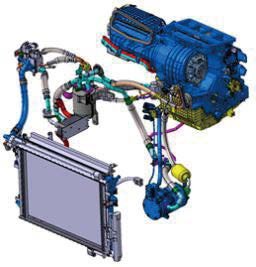
Technology overview: The traditional air conditioning devices for electric cars are comprised of a cooling system that uses refrigerant, ie. vapor compression cycle, and a heating system that uses an electric heater, and it operates these two systems at the same time to maintain an appropriate temperature and comfort inside the car. This product has commercialized a heat pump system for electric car, which uses the existing vapor compression cycle, capable of using the cold spot of refrigerant for cooling use under the condition where outdoor temperature is high, and the hot spot https://korean-machinery.com///inquiryof refrigerant can be used for heating use under the condition where outdoor temperature is low. Traditional heaters that use electricity have thermal efficiency lower than 1 (0.9~0.95), consuming electricity energy more than required quantity of heat. While, the heat pump  system  has COP bigger  than 1 at all times (1.5~4), which helps reduce energy consumption by 30~60% compared to the system that uses an electricity heater to get the equivalent heating performance. In addition, it collects waste heat generated from application components of an electric car, such as inverter and drive motor, with the use of the heat pump system helping improve COP and reduce parasitic power. As a result, we could extend distance per charge by about 21% through power saving of the battery of a system requiring heating source up to 7kW for an electric car, and we have secured technology for domestically designing a heat pump system for electric cars.

Industrialization: With regard to developing a high-performance heat pump system using waste heat for the first time in the world, we have enhanced the endurance for components, at the same time being capable of domestically producing all components except for a refrigerant change valve. In addition, as we have realized power saving required for heating the inner space of a vehicle, compared to other competitor’s performance, with driving distance per charge of an electric car being increased. With this, we could satisfy customers’ requirements for increasing driving distance per charge, and have secured better competitiveness than our competitors, resulting in enhanced productivity. Further, with respect to applying a heat pump system to a vehicle, it was required to run dehumidifying and defrosting operations at the same time to remove moisture and frost on the window to assure a driver’s visibility and automatic temperature variable control operation to control the indoor air conditioning. To realize these, we have implemented integrated control logic of optimized operation satisfying the performance required by an air conditioning system for automobiles by properly combining cooling/heating modes, frost recognition and continuous operation modes. As a result, we have secured an independent technology for domestically designing a high- performance heat pump system.

Untitled-17Problem-solving in industrialization: With respect to developing a high-performance air conditioning system to extend the driving distance of an electric car, we have dramatically extended it by about 21% when running a heating system through COP improvement and power-saving by collecting only waste heat generated from application components, such as an inverter and a drive motor, of an electric car with the use a heat pump system. Then, with respect to extending the operation range of a heat pump system when it is -20℃ outside, a heat pump system tends to have deteriorated performance and endurance as the exterior temperature becomes low, due to the characteristics of refrigerant. Thus, it was not possible to run the system at low temperatures. This technology enables the waste heat generated in the application components suffers heat exchange with the refrigerant of low temperature at the entrance of the compressor, increasing the amount of refrigerant flow, and leading to secure an endurance enabling the system to run at up to -20℃. Finally, with respect to developing control technology enabling continuous operation after recognizing frost generation and ice formation on the outdoor fan, in order to overcome the frost generation and ice formation issues, which are chronic ones of a heat pump system, we have developed a method to recognize frost generation and ice formation in an outdoor fan, leading the refrigerant to the inner circulation cycle mode if frost generation is recognized so that the heat pump can continuously work in the heating mode without having a section of defrost operation.

Technology developer:

Hyundai Kia Motors / +82-80-600-6000 / www.hyundai.com

Hanonsystems Co., Ltd. / +82-42-930-6114 / www.hanonsystems.com

korean-machinery.com | Blog Magazine of korean-machinery, brands and Goods

Polymer new material stone unit panel system

Technology overview: Structures that are recently being constructed are often high-rise buildings of various forms, in particular reflecting the trend of luxurious image. According to this construction trend, the external walls of the structures are getting using stones, the representative high quality finishing materials showing outstanding endurance. When using stones as finishing materials for mid-to-high rise buildings, the wet construction https://korean-machinery.com///inquirymethod using mortar is often adopted, which requires longer construction period and has issues like whiteout. To deal with these issues and reduce the weight of stone finishing materials used in high rise buildings, dry construction method, including a setting method, is used, which uses adhesive and connecting hardware for weight lightening. However, stones are heavy objects and raise issues at the connecting part of the structure, and as time goes by, significant pollution tends to occur around masonry joint that connects stone plates, which is harmful to the aesthetics of a building. This technology uses polymer new material for an economic and efficient exterior finishing method for structures, capable of resolving issues of the dry construction method. This technology synthesize stone and steel frames using polymer new material, filling in and synthesizing the polymer new material based on the existing method that connects stones and steel frames with iron goods, resulting in preventing the masonry joint of an external wall from being polluted due to rainfall infiltration, and improving heat insulation property. As it is possible to do manufacture by a large panel system unit, this technology reveals structural stability and outstanding construct ability, above all, and even it is easy to do maintenance after construction.

Industrialization: This technology mainly applies to environment-friendly buildings and the external wall construction of buildings which require a high energy management class, and as it helps shrink the thickness more than the stones used in the existing buildings, it is an economic technology contributing to cutting down on construction cost. Further, we have recently developed and applied steel frames that are optimized enough to saving construction cost, and have introduced a system that helps shrink term of works by streamlining installation processes of the fields. Due to these, Samjistone Co. Ltd., which joined in the development of this technology has achieved field application results worth more than KRW 5 billion since the technology development, and it is expected that it will be able to reach more than KRW 10 billion by 2016. In addition, many overseas project sites other than the existing ones are vigorously applying this technology to their works.

Problem-solving in industrialization: For the existing exterior masonry stone works, similar to this technology, it is essential to do the works on a scaffold or a gondola, which is vulnerable to risks. However, this technology involves producing stones by panel unit and using cranes to install them so that we can do construction works safely than before. As most construction works use equipment, it is possible to do the works with one-third of the manpower used in the existing exterior stone works, which helps lower the rate of human life loss accidents. Moreover, as it does not produce dusts or wastes coming from stones cutting, scrap stones or the pallet of imported stones, we can minimize civil complaints raised around the field, and in particular, this technology is better suitable to a construction field that is located in downtown areas.

Technology developer:

Myongji University’s Industry and Academy Cooperation Agency / +82-31-324-1063 / www.mju.ac.kr

 Keimyung University’s industry and academy cooperation agency / +82-53-580-6708 / www.kmu.ac.kr

Samjistone Co., Ltd./ +82-2-981-0027 / www.samjistone.co.kr / Basf Korea / +82-2-3707-7529 / www.basf.co.kr

korean-machinery.com | Blog Magazine of korean-machinery, brands and Goods
Environment-friendly propeller cavitation performance control technology

Technology overview: Identifying the cavitation performance of a real vessel propeller through a model propeller test is critical as it forms the basis of vessel propeller design and technology development. We have developed a three-dimensional ship wake flow reproduction technique and a model propeller cavitation performance test technique, which minimize the effect of Reynolds Number, generated due to difference in velocity of flow, and the relative sizes of a model vessel, used in the model test, and a real vessel.

https://korean-machinery.com///inquiry

We have compared and verified the results of the model test with the results of the real vessel propeller real sea trial run, and found it shows excellence in the generation of a real vessel propeller cavitation, and the expected level of variable pressure and propeller noise. Such foundation technologies apply to mostly commercial vessels, including container ship, LNG carrier,  LPG carrier,  VLCC, and PC. We have gathered credible data on various vessel types. We have secured a technology capable of estimating a vessel body’s effective velocity, which uses the numerical analysis of organic speed generated by a propeller, and the results of total velocity measurement of a propeller, in a large cavitation tunnel. We have developed a numerical analysis technique that helps optimize the load distribution of a propeller and minimize cavitation generation, seeking for improving the efficiency of controlling and propelling a propeller cavitation, based on the aforementioned test techniques. We also have developed a technology for verifying the torque balance of a counter rotating propeller (CRP), a technology for improving propulsion efficiency using a Hub Vortex Control Fin, a technology for reducing the cavitation of a propeller blade and controlling the wake flow of a ship body, which makes use of a Vortex Generator, and a technology for reducing and stabilizing cavitations on a Rudder’s tip and shoe.

2016-03-17 09;01;20.PNG

Industrialization: The method of testing a large cavitation tunnel, developed in this project will apply to a model test for propulsor and will be used in the cavitation performance verification of a propeller designed in the basic design stage before constructing a vessel, followed by suggesting the direction of design improvement, based on the results. For example, for a 8800TEU container ship, we designed it having the optimal ratio of the expanded area ratio reduced by 15~20% based on the credible results of the model test, resulting in propelling efficiency improved by about 3~4%, and we were successful in commercialization. Moreover, the numerical analysis technology for optimizing propeller design has been transferred to the participating companies and being in use in designing propellers for export vessels. Currently, the research results of this project are utilized not only in the verification of commercial vessels’ propeller cavitation performance, built by domestic shipbuilders and technology development, but also in the national R&D research projert.

Problem-solving in industrialization: Cavitation, generated in a vessel’s propeller, gives various harms, including reduced propelling force and efficiency of a vessel, generation of variable pressure triggering vibrations in the vessel body, eroded surfaces of propellers and rudders, and radiated noise under the water. As such phenomena are not still fully numerically analyzed around the world, we are applying experimental methods at the same time to verify the technology. When we needed to submit precise test results, we had no option but to use foreign test facilities because we were lack in a large cavitation tunnel. Now, we have domestically secured the related test facilities, performance tests and designing methods, as aforementioned, it is now possible to conduct a credible verification in Korea. The technologies will contribute to improving domestic shipbuilding industry’s competitiveness in receiving orders due to the technological superiority, and will give a foundation to independent technology development.

Technology developer: Korea Research Institute of Ships and Ocean Engineering (KRISO) / +82-42-866-3114 / www.kriso.re.kr

korean-machinery.com | Blog Magazine of korean-machinery, brands and Goods

Next-generation semiconductor wafer level wiring material technology

Technology overview: With regard to manufacturing the next-generation high-density semiconductor device, a process that uses Cu substituting the existing AI material has been realized and semiconductor companies of other countries are actively conducting studies on the Cu wiring process. In these circumstances, in the material sector, which is a rear industry, leading companies of other https://korean-machinery.com///inquirycountries are supplying technocratic products to the market to response to the technology. With domestic  ICT industry,  which is a front industry, having good international competitiveness, we need to enhance the domestic material industry’s technology power to create a stable industrial environment in the future, and to maintain our competitiveness. At this time, we have developed technologies for manufacturing  Cu, Ta and Ni-Cr sputtering targets to apply to the next generation semiconductor, through the project. The sputtering target adopts the PVD method and is used in the form of high purity monometal or alloy as raw material for laminating thin-film onto the substrate. As it is used in LCDs, semiconductors and HDD storage devices to form thin-films of IT devices, it conditions not only the properties of a thin film, but also the performance of an IT device as a key raw material. So, it is required to secure a technology for controlling the purity and microtissues of a material, and to apply the technology to the industrial setting. It is also required to optimize these technology elements. With respect to the Cu target, we have developed a textured material having purity 6N, crystal grain sized 10㎛ or less, and 30% or more of <111>//ND; and a target which sputter yield is improved by 39% compared to the existing target. For Ni-Cr target, its average crystal grain is sized between 0.2 and 2.8㎛, and we have developed a target having a sputter yield at the same level to the existing target for common use.

Industrialization: We have industrialized  Cu(>4N5 grade) and Ni-Cr(>2N5 grade) target products since 2011, creating sales amount of KRW 1,200 million and KRW 2,800 million, respectively, until 2014. We have secured some KRW 1 billion of fixed sales every year, and we are now preparing for subsidiary facilities such as a clean room in order to penetrate the semiconductor target market in the future. We have expanded and transferred our factory in 2014 to enhance our competitiveness in terms of size and quality, and making use of the high purity metal dissolution process technology and microtissue controlling technology, developed through the project, we are expanding our business area to other high-value metal product manufacturing.

Problem-solving in industrialization: With respect to Cu (>4N5 grade) and Ni-Cr (>3N5 grade) sputtering targets, developed through technology development, a credibility test by consumer and a field optimization stage were carried out, and we are now in the delivery stage. For Cu (>6N grade) sputtering target, which is a product of semiconductor class, as the requirements for credibility rather than price has priority, it is required to grow material companies in terms of quality and quantity in order to substitute the existing suppliers, i.e. foreign leading companies.

Technology developer: HanKook Vacuum Metallurgy Co., Ltd. / +82-31-433-7477 / www.hvm.co.kr

korean-machinery.com | Blog Magazine of korean-machinery, brands and Goods

Ultralight aluminum heat-shield manufacturing technology for automobile engines with its heat radiation and vibration endurance improved by 10%

Technology overview: Heat-Shield for automobile engines protects parts vulnerable to the heat generated around the engine by shutting off high-temperature heat and noise that are radiated from the exhaust system during the engine stroke, and improves the https://korean-machinery.com///inquiryinner environment and ride comfort of a vehicle. Technology reports, produced by overseas leading companies in the countries such as Germany and Japan, suggested that a heat-shield that uses aluminum plate can shut off heat and reduce vibrations, as well as can reduce noise greatly. Thus, many domestic companies tried to domestically produce it, but it was hard to produce a copied one because of its complex shapes, and they also had limitations in their original shapes, resulting in creating no outcome with regard to the domestic production. Currently, domestic technology is on the level of applying an embossing shape to a single aluminum plate, and the aluminum composite panel heat-shields having good performance had been all imported from overseas companies. Amid the recent improvement of automobile engine performance and efficiency, the roles played by the heat-shield and specifications for required performance are getting enhanced. We have developed a lightweight aluminum heat-shield made of aluminum materials having a specific gravity of 30% level and more than three times of thermal conductivity compared to the traditional steel materials. To implement not only light weight, but also stiffness, heat insulation, vibration control and lower noise properties at the same time, we have developed a heat-shield manufacturing technology that has a structure of stacking aluminum plates in multiple layers. As such, we have secured a manufacturing technology for parts and materials, which can contribute to the future eco-friendly green growth. We have domestically developed an aluminum heat-shield manufacturing technology having good performance compared to overseas advanced parts, through R&Ds, which satisfies the intent of the parts and materials technology development enterprise, enhances our country’s competitiveness, and substitutes imported ones.

Industrialization: We have secured our own composite panel sectional shape, applicable to the heat-shields for automobile engines, and domestically developed a composite panel manufacture technology of sandwich structure, holding a process patent capable of producing the pattern shape of a specific model, with the patents pending in overseas countries such as China and India. We have developed a device capable of simultaneously forming plates of sandwich structure, reducing investment and production costs due to reduced processes. Based on the patent holding, production cost reduction, securing a peculiar model and our own aluminum composite panel manufacturing technology, we are carrying out a practical endurance assessment to apply the technology to mass production, in collaboration with a automotive company, to domestically produce aluminum heat-shield parts that have been imported. In addition, we have provided a samples to carry out an assessment for mass production application, at a demand from an Indian automobile company, and a practical performance assessment is being carried out.

Problem-solving in industrialization: To conduct a heat radiation assessment, a key function of the heat-shield, we tried to commission a standardized testing institute to conduct the tests. As there were no efficiency evaluation standards nor testing devices for heat-shield parts, we manufactured a testing facility ourselves and performed verifications and calibrations, establishing an efficiency evaluation system, and based on this. In addition, we manufactured a sample of the practical application model after conducting a plate forming interpretation and physical modeling test, performing a practical evaluation according to the customer company’s standard.

Technology developer: Saehan Industry Co., Ltd. / +82-31-499-3355 / www.saehani.com  IAE / +82-31-330-7516 / www.iae.re.kr

korean-machinery.com | Blog Magazine of korean-machinery, brands and Goods

Technology development of application & integrated control for the commercialization of the 4WD electric tractor with 35hp

Technology overview: Responding to strengthened regulations by advanced countries for exhaust https://korean-machinery.com///inquirygas and fossil fuel depletion, the development of an electrical-powered tractor that uses conversion from fossil fuel to electric energy as power source was conducted as a top priority in order to remove trade barriers caused by regulation of exhaust gas of advanced countries and to pioneer a new market. Through a project for development of components and materials, the purpose was to develop pure electric system that can replace diesel engines, and the pure, genuine, electric tractor was the world’s first product of its kind. In order to realize the same performance as the existing diesel tractor, its weight was reduced to be lightweight, and construction technology for the optimal layout of components for creating the maximum traction power was developed. In addition, the structure was built so that battery, a heavy material, can be easily detached and attached, with a patent application completed.

For vehicle simulation through ASM and Carsim software, tractor modeling was developed so that simulation can be performed through defining electrical property parameters of core electronics such as motor, battery, and inverter and parameters for driving environment such as condition of packaging. Unlike electric cars, agricultural tractors perform high-load works consistently under poor conditions; therefore, with consideration of environmental conditions such as temperature and waterproofing, motor, inverter, battery, BMS system, transmission, and hydraulic system were developed to be suitable for agricultural use.

In order to increase use time by one charge, the research on improvement of energy efficiency was conducted through development of vehicle integrated control logic and echologic linked to an integrated controller. In particular, a dual-motor system was implemented in order to perform driving and jobs, and development of optimally integrated control logic was completed through the research for maximizing energy efficiency when two motors simultaneously perform jobs and driving.

Industrialization: Currently, a market for urban tractor attached with farm working machinery is being developed so that it can be used in amusement park, arboretum, and public offices that are sensitive to exhaust gas and noise. A market was opened through a target strategy focusing on closed workspace such as vinyl greenhouse and areas where agricultural products that are sensitive to exhaust gas are processed, such as orchards, and the business can be expanded to construction and transfer of indoor distribution.

Problem-solving in industrialization: Comparing the cost of lithium battery and use time with those of diesel tractor, prejudice about a tractor being only used for agricultural purposes, etc.

Technology developer:

Daedong Industrial Co., Ltd. / +82-53-610-3000 / www.daedong.co.kr

VCTech Co., Ltd. / +82-31-477-5050 / www.vctech.co.kr

Motion Control & Systems Co., Ltd. / +82-32-621-3322 / www.mcsys.co.kr

PNE Solution  Co., Ltd. / +82-31-343-1221 / www.pnesolution.com

Daedong Gear Co., Ltd. / +82-55-851-2448 / www.daedonggear.com

Hydrotech Co., Ltd. / +82-53-593-8468 / www.hydrotech.kr

University of Ulsan / +82-52-259-1287 / www.ulsan.ac.kr

korean-machinery.com | Blog Magazine of korean-machinery, brands and Goods

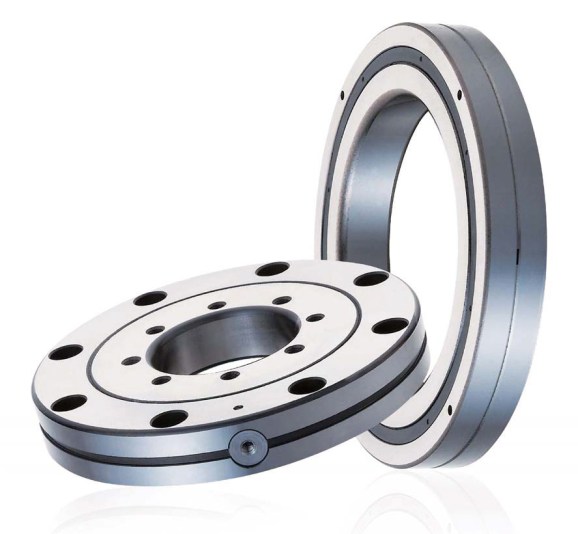
Cross-roller rotation bearing that has rotation precision of 5㎛(outer rim) 3㎛(inner rim), endurance time with more than one million rotations, and diameter of 150nm and 250nm

Technology overview: Heavy-duty cross-roller rotation bearings are mainly composed of outer rim, inner rim, roller, retainer and seal. Outer rim and inner rim are made with bearing steel (SUJ2) with high abrasion resistance and rigidity. Since rotation is conducted by roller as a medium, low friction resistance, stable rotary motion and high rotation precision can be realized. For smooth circulation of roller, skew (misalignment of roller) is prevented by space retainer, and side seal is attached in order to block penetration of external, foreign substances. The developed product selects a structure equipped with space retainer, which reduces noises in rotary movement and enables precise rotation.

https://korean-machinery.com///inquiry

Industrialization: There has been dramatic increase of demand in the field of machine tool and industrial automation such as turning joint area of robot, rotation table in machining center, precision rotation stage, and medical equipment. In addition, the export to Southeast Asia, Europe and the USA is expected to grow. Therefore, more investments need to be recruited to maximize production and train technicians, thereby improving competitiveness through high-quality, rapid delivery, and cost reduction.

Problem-solving in industrialization: Domestic production of heavyweight cross roller circular bearing is still in early stage, and in fact, products made by Japan THK have dominated the Korean market. Technology in cross roller guide by MID, which can be considered as directly related technology, is the most advanced in Korea, and development of gonio cross roller guide was completed as the first in Korea and is now being marketed. Currently, MID mostly manufactures precision guide; however, endurance time and productivity have been improved to be competitive against advanced, foreign companies. In addition, test equipment for self-evaluation of durability have been established, authorized by national certification organization. Based on this, industrialization has become successful through mass- production.

Untitled-8.jpg

Technology developer: MID / +82-31-998-9581 / www.midcop.co.kr

korean-machinery.com | Blog Magazine of korean-machinery, brands and Goods

Fine pulverization technique utilizing jet milling technology for production of aluminum powder

Technology overview: https://korean-machinery.com///inquiryA pulverization technique preventing stickiness and clotting in high speed pulverization of aluminum scrap that is ductile and has low melting point was developed. Localization of the related technology was made possible due to development of fine pulverization technique of aluminum. Jet milling technology cannot be leaked outside. Developed technology was applied with expansion to Flexible  PCB board that has similar properties with aluminum among wastes of electrical and electronic equipment. For aluminum scrap that contains more than 98% aluminum, the technology overcame ductility and low melting point, and fine pulverization technique without the risk of explosion of aluminum powder was developed while removing various foreign substances included in aluminum scrap, thereby developing manufacturing technique of high value-added aluminum fine powder with more than 98% of aluminum and below 0.4% impurities.

Untitled-7Industrialization: Environmental-friendly method through re-utilization of aluminum wastes and reduction of carbon emission was developed. Aluminum granule (99%) is used as a material for high-quality ferroalloy (ferromolybdenum, ferrovanadium), and the size of the global market is about KRW 500 billion. Therefore, the balance of trade would be achieved with exports around the world. Essential technology and recycling facilities will be exported.



Problem-solving in industrialization: To overcome ductility, ultra-high speed pulverization (higher than 3500rpm) is utilized to pulverize ductile metals. For milling foreign substances in the surface, the gap in still blade and rotator blade is controlled from 8mm to 1mm in stages to provide crush effect in cutting process simultaneously, thereby polishing on the surface. Since the gap in still blade and rotator blade is at least 1mm, flexible plastic that is not sorted out by magnets will not be cut and extracted out as large particle. For overcoming low melting point, the flow of pulverized materials inside high-speed milling machine is controlled through air flow made by strong turbo impeller, creating natural pneumatic system. Through a 25RW cooler (water cooling jacket in pulverized space of pulverization machine) and sensor for indicating temperature of discharged air in the indicator, the input amount of materials can be controlled, thereby setting the temperature below 80˚C (controller).

Technology developer: JMTECH Co., Ltd. / +82-31-997-4437 / www.jmtechkorea.com

korean-machinery.com | Blog Magazine of korean-machinery, brands and Goods